

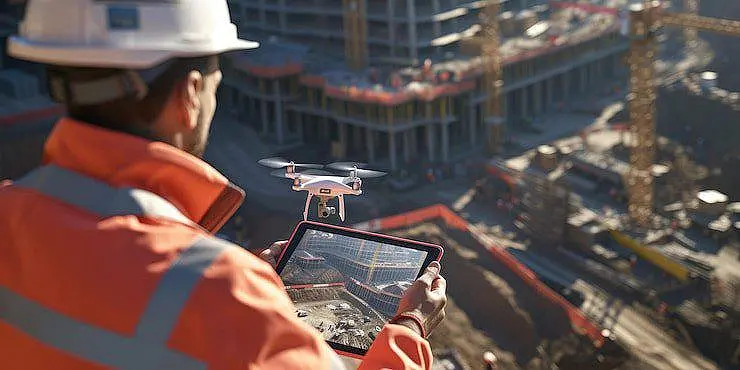
A superintendent should not have to piece together jobsite status from text threads, scattered photos, and a walk of only the areas reachable before the next meeting. Construction progress drone monitoring gives project teams a consistent aerial record of what changed, what stalled, and what needs attention now. When it is done correctly, it becomes more than visual documentation. It becomes a repeatable field-data workflow that supports schedule control, owner updates, dispute avoidance, and better site decisions.
What drone construction progress monitoring actually delivers
On active projects, the value is not the drone flight itself. The value is the output. That includes current orthomosaic maps, high-resolution site imagery, video updates, 3D site models when needed, and date-stamped records captured from the same angles and elevations over time. For commercial builders, developers, and engineering teams, that consistency is what turns aerial capture into usable project intelligence.
A single progress flight can show material staging, earthwork advancement, access conditions, structural sequencing, utility installation, façade progress, roofing status, and site logistics in one pass. Compared with ground-only reporting, aerial monitoring compresses a wide jobsite into a format decision-makers can review quickly. It also helps bridge the gap between field teams and stakeholders who are not on site every day.
This matters most on large, fast-moving, or complex sites where blind spots create expensive assumptions. If a project owner, lender, or program manager needs to verify progress against schedule, drone-based documentation provides a current visual baseline without relying on fragmented updates.
Why construction progress drone monitoring is becoming standard
Projects are under pressure from every direction – labor availability, schedule compression, weather delays, documentation demands, and tighter owner scrutiny. In that environment, incomplete site visibility is not a minor inconvenience. It slows decisions and increases risk.
Construction progress drone monitoring helps solve a practical problem: teams need current information without adding more field burden. A planned flight can capture the entire site in less time than a manual photo walk, especially on multi-acre developments, industrial builds, roadwork, and infrastructure corridors. That speed matters, but accuracy matters more. The right workflow gives teams data they can compare week to week or month to month, not just attractive footage.
There is also a documentation benefit that becomes clear later, often when a question comes up about sequencing, site conditions, stored materials, or milestone timing. Having a consistent aerial archive can support pay application reviews, client communication, internal reporting, and claims defense. It will not replace project controls, but it can strengthen them.
What good progress monitoring looks like in practice
The difference between basic drone media and a commercial monitoring program is planning. A useful program starts with the reporting need. Some clients need weekly overviews for active vertical construction. Others need monthly mapping to track civil work, drainage, utility corridors, or concrete placement. The flight schedule, capture points, and deliverables should match those operational goals.
Repeatability is critical. If every visit uses different altitudes, different camera angles, or different coverage areas, comparison becomes harder. A disciplined operator builds a repeatable capture plan so progress can be reviewed against prior flights with minimal guesswork. That is how teams spot meaningful changes instead of wasting time interpreting inconsistent imagery.
Deliverables should also fit the audience. Superintendents may want broad overhead maps and targeted views of problem areas. Executives may need concise visual updates for internal reporting. Owners and lenders often want date-stamped evidence of milestone progression. Engineering and project management teams may need orthomosaics or modeled outputs they can use alongside plans and field documentation.
Where the biggest value shows up
Earthmoving and site preparation are obvious use cases because aerial perspective makes quantity movement and drainage patterns easier to assess. But the value continues through the full project lifecycle. During structural work, teams can track sequencing, crane access, deck progress, and material storage. During envelope and MEP phases, aerial documentation helps confirm staging, roof activity, and external system installation.
For infrastructure and energy projects, drone monitoring becomes even more useful because the work footprint is often too large for efficient ground-only review. Linear projects, industrial plants, substations, tank farms, and utility corridors benefit from a current visual record that shows both progress and access conditions across a broad area.
There is also a communication value that should not be overlooked. Progress images and maps help align owners, contractors, consultants, and remote stakeholders around the same current view of the site. Fewer assumptions usually means fewer avoidable conversations later.
The trade-offs teams should understand
Drone monitoring is not a substitute for every field inspection. It will not reveal every installation detail under a canopy, inside enclosed spaces, or beneath active work zones. If a team expects one flight to answer every project question, the program will disappoint them. The right approach is to use drone data where aerial visibility adds speed, coverage, and context, while ground teams continue to verify detail-level conditions.
Weather is another variable. Wind, rain, and changing site conditions can affect flight timing and image consistency. That does not make the process unreliable, but it does mean scheduling should be handled by operators who understand jobsite realities and can maintain quality standards across repeat visits.
There is also a difference between collecting content and producing decision-grade data. Plenty of providers can capture video. Fewer can produce engineering-ready deliverables, maintain repeatable flight plans, operate under the right approvals, and tailor outputs to project controls. For commercial clients, that distinction matters.
How to evaluate a construction progress drone monitoring provider
Start with operational capability, not marketing. The provider should understand active jobsites, safety coordination, airspace restrictions, and the documentation needs of commercial teams. FAA compliance is a baseline. For certain sites and airspace conditions, waiver-backed capability and experience with controlled environments can make a real difference in whether the work gets done on schedule.
Next, look at deliverables. Ask what you will receive after each flight and how those outputs will be organized. If the answer is limited to edited video and a photo folder, that may be enough for marketing, but it is usually not enough for project oversight. Strong providers can deliver structured imagery, progress comparisons, Orthomosaic mapping where needed, and reporting formats your team can actually use.
It is also worth asking how the flights will stay consistent over time. Repeatable progress monitoring depends on planned viewpoints, documented flight paths, and standardized capture methods. Without that discipline, the archive becomes less useful as the project advances.
Finally, consider responsiveness. Construction schedules change. Milestones shift. A useful monitoring partner needs to support recurring assignments but also adapt when a critical pour, lift, inspection window, or owner visit changes the reporting priority.
Turning drone flights into better project decisions
The best construction progress drone monitoring programs are tied to a decision cycle. They are not performed just because a calendar says it is time to fly. They are aligned with project milestones, reporting deadlines, coordination meetings, and documentation needs.
That might mean weekly capture during heavy site activity, then shifting to milestone-based updates later. It might mean combining overhead mapping with targeted photo documentation of access roads, laydown areas, façade elevations, or roof zones. On some projects, a simple visual record is enough. On others, teams need high-accuracy mapping and measurable outputs that support engineering and management workflows.
That is where experienced commercial operators stand apart. A service company such as Drone Services Texas is built around usable outputs, not generic footage. For clients managing active construction, industrial, and infrastructure projects, that difference shows up in faster reporting, clearer oversight, and data that supports action instead of just observation.
Construction teams do not need more content. They need a current, reliable picture of the site that helps them make the next decision with less guesswork. When progress monitoring is built around that standard, it earns its place in the project workflow.