

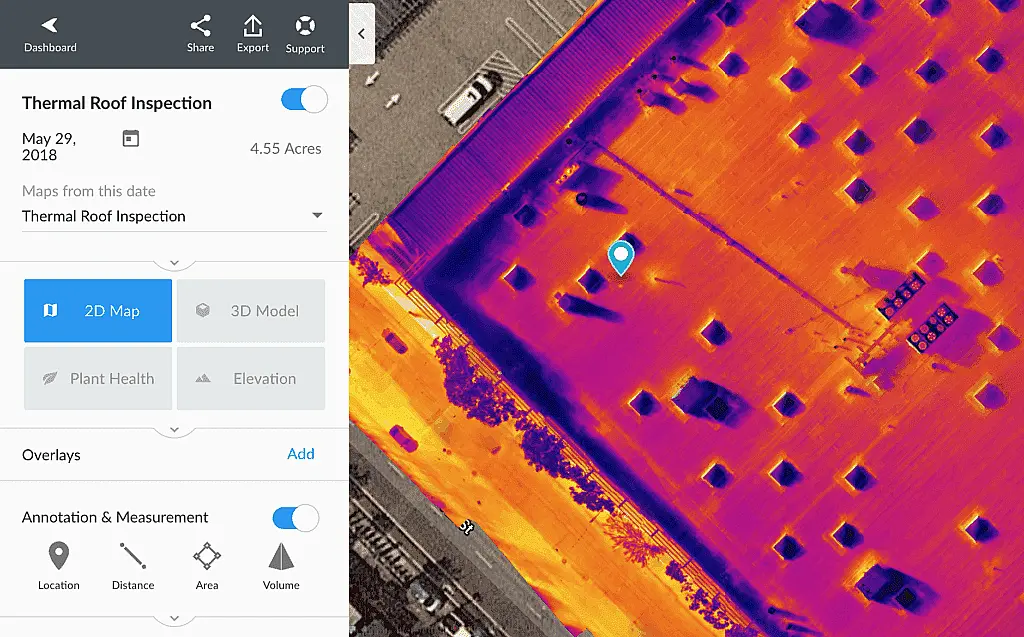
 A roof can look fine from the parking lot and still be holding moisture, losing energy, or hiding failure points that turn into expensive disruption later. That is where a thermal drone roof inspection changes the conversation. Instead of relying on limited visual access, property teams and facility decision-makers get a faster view of temperature anomalies across the full roof system, with data they can use for maintenance planning, warranty review, insurance documentation, and repair scoping.
For commercial buildings, the issue is rarely just finding damage. The real challenge is finding the right damage early enough to act before it spreads. On a large warehouse, retail center, office building, plant, or institutional facility, manual walkovers take time, create safety exposure, and often miss the broader thermal pattern that explains what is actually happening.
What a thermal drone roof inspection actually shows
Thermal imaging does not see moisture directly. It detects temperature differences across the roof surface. Those differences can point to trapped moisture in insulation, wet roofing materials, thermal bridging, active leaks, poor drainage, membrane separation, or areas where the roof is behaving differently than surrounding sections.
That distinction matters. A thermal image is not a final diagnosis by itself. It is a high-value screening tool that helps identify suspect areas quickly and at scale. In practice, that means a building owner or asset manager can focus follow-up testing, core samples, or targeted repairs where the data shows the highest likelihood of a problem.
On low-slope and commercial flat roofs, this is especially useful because moisture migration is often wider than the visible stain inside the building. By the time interior symptoms appear, the affected roof section may be larger than expected. Thermal data helps narrow that uncertainty.
Why drones improve roof inspection workflows
Traditional roof inspections still have their place, but they come with friction. Access coordination, fall exposure, limited line of sight, and inconsistent documentation all slow the process down. A drone-based thermal inspection reduces that friction while expanding coverage.
A drone can capture thermal and visual data across large roofs in a fraction of the time required for manual walking, especially where access is restricted or roof layouts are complex. It also creates a documented record of conditions at the time of inspection, which is valuable for capital planning, contractor coordination, disputes, and recurring monitoring.
For multi-building portfolios, the advantage is even more practical. Standardized data capture makes it easier to compare structures, prioritize repairs, and allocate maintenance budgets based on observed conditions rather than assumptions.
When thermal roof data is most useful
Not every roof issue needs a thermal survey, and not every thermal survey should be treated the same way. Results depend on roofing material, weather, time of day, solar loading, recent rainfall, and the specific problem being investigated.
A thermal drone roof inspection is often most effective when there is enough thermal contrast for anomalies to stand out. For many commercial roof systems, that means capturing data after the roof has absorbed heat and is releasing it, often later in the day or early evening. Wet insulation and saturated materials may retain heat differently than dry areas, creating the contrast needed for interpretation.
That also means timing matters. If the roof was recently rained on, heavily shaded, or affected by changing wind conditions, the thermal pattern may be less reliable or require tighter interpretation controls. This is why experienced flight planning and inspection context matter as much as the camera itself.
What commercial clients can expect from the deliverables
The most useful inspection is not the one with the prettiest thermal image. It is the one that produces usable information. Commercial clients typically need annotated imagery, visual and thermal comparisons, identified anomaly areas, roof section references, and files that can move into maintenance, engineering, or insurance workflows without extra translation.
That is the difference between basic aerial media and decision-grade inspection output. A facility team may need to know where to send a roofing contractor. An engineer may need thermal evidence to support further testing. A commercial real estate stakeholder may need documentation for due diligence or asset condition review. The inspection should support those decisions directly.
When the scope is handled correctly, the output can help reduce unnecessary roof tear-off, focus repairs on affected zones, and create a clearer record for future inspections. It can also support recurring monitoring for roofs with known issues, where trend visibility is more valuable than a one-time snapshot.
Thermal drone roof inspection and risk reduction
Safety is one of the clearest operational benefits. Large roofs, aging surfaces, active facilities, and difficult access points all increase inspection risk. A drone reduces the need for extended foot traffic on the roof while still capturing broad coverage.
That does not eliminate the need for on-roof validation in every case. It simply reduces guesswork and helps teams deploy hands-on inspection resources where they are needed most. For owners and operators managing multiple sites, that is a meaningful efficiency gain.
There is also a cost control angle. Water intrusion that is caught early is usually cheaper to address than widespread insulation saturation or structural deterioration that goes unnoticed. Thermal mapping helps expose issues that are still developing, which gives decision-makers more options and often better repair economics.
Where thermal inspection fits in the commercial process
For some clients, roof thermal inspections are reactive. There is an active leak, tenant complaint, storm question, or insurance issue that requires fast documentation. In those cases, speed matters, but clarity matters more. The goal is to identify likely problem zones quickly enough to support a field response.
For others, the work is proactive. Portfolio managers, facility operators, and building owners may use thermal inspection as part of seasonal maintenance, pre-acquisition review, or capital planning. That approach tends to deliver the strongest financial value because it shifts roof management from emergency response to planned intervention.
Construction and redevelopment teams also use thermal surveys for punch list support, warranty concerns, and post-installation checks where hidden defects need to be screened without disrupting operations.
Limits, trade-offs, and why experience matters
Thermal imaging is powerful, but it is not magic. A hot or cool spot does not always mean moisture, and some moisture conditions may not present clearly depending on weather and material behavior. Reflective surfaces, HVAC influence, debris, ponding, and recent environmental changes can all affect readings.
That is why interpretation should stay grounded in building context. Roof type, drain layout, membrane condition, insulation type, occupancy issues, and recent repair history all influence what the data means. A useful provider does not oversell certainty. They explain what the imagery indicates, where confidence is high, and where confirmation testing may still be needed.
This is also where FAA-compliant operations, flight planning, sensor selection, and repeatable capture methods matter. If the mission is rushed or the thermal conditions are wrong, the output can be less actionable. The goal is not just to fly a drone over a roof. The goal is to collect reliable inspection data under conditions that support sound interpretation.
Choosing the right provider for a thermal drone roof inspection
Commercial buyers should look past generic drone marketing and ask practical questions. What deliverables are included? Is the inspection structured for engineering, facility, or insurance use? Can the team work active sites safely and legally? Do they understand how to capture both visual and thermal evidence in a way that supports maintenance decisions?
It also helps to work with a provider that understands larger operational environments, not just isolated buildings. Industrial sites, distribution centers, commercial campuses, and infrastructure-adjacent facilities often require coordinated access, defined flight safety protocols, and documentation that fits existing project workflows.
That is the standard companies like Drone Services Texas are built around – not just collecting images, but producing inspection data that supports action.
A roof problem rarely gets cheaper by waiting for it to become obvious. The better move is to document conditions while options are still open, so the next repair decision is based on evidence instead of assumption.